Friday, 17 December 2010

Pakistan spooks kill brothers of forcibly disappeared: report


WASHINGTON DC: Brothers of at least two victims of enforced disappearances have been killed extra judicially by Pakistan intelligence services, a premier organization that helps protect human rights Voice of Copts was informed Thursday.
There have been cases in recent weeks a brother who tries to secure the release bof victim of enforced disapperances by creating public awarness is killed by the secret agencies.
Asim Karim Baloch, 18, was a student of Multan Polytechnic College and a member of Baloch Students Organization Azad. The teenager was abducted after he addressed a press conference against the abduction of his brother Tariq Karim Baloch.
Tariq Karim Baloch was abducted on 26 October 2010.
Asim Karim Baloch's body was found in Khanozai area on 1 November 2010.
Mujeeb Baloch, unit secretary of Baloch Students Organization Azad was abducted from Balochistan University on September 1, 2009 while his brother Yaseen Mohammed Shahi, who was running from pillar to post for the release of his brother was shot dead in Kalat town on October 10.
Fates of Tariq Karim Baloch and Mujeeb Baloch are not known.
Pakistan's human rights violations are happening under the very nose of the Department of State and Balochistan analysts in North America it seems like the late Afpak Czar, also called Raging Bull, Richard C. Holbrooke, had given an assurance the U.S. woud keep quiet on the miltary atrocities in Balochistan.
Military brutalities in Balochistan are part of the military's strategic depth policy that might turn Balochistan into a second Afghanistan if the cancer is not treated through balkanization of Pakistan, these Baloch analysts warn.
The report presented to Ashraf Ramelah, founder and president of the Voice of Copts, bared the gross human rights violations of the Baloch both in Pakistan and Iran.

Thursday, 16 December 2010

Abdul Sattar Purdely: Baloch intellectual from Afghanistan


Interview by Karlos Zurutuza

A former MP during Najibullah´s rule and president of the Afghan Trade Unions of Afghanistan for more than ten years afterwards, Mr. Purdely is today one of the main advocates for the Baluch’s language and culture in Afghanistan, a work he conducts from his position at the Centre for Regional Studies of Afghanistan.

Abdul Sattar Purdley, what is the security situation for the Baluch in Nimroz and Helmand provinces?

Helmand is far from being under Kabul´s control and the local population, whether they are Baluch, Pashtun or Tajik, are suffering the most direct consequences of this war. The situation in Nimroz is a bit better. Zaranj, the provincial capital, is under the control of Kabul but NATO is not present except for a small military presence in Delaram district, on the opposite side of the borders with West and East Baluchistan. Neither is there a PRT (Provincial Reconstruction Team). The Taliban are in control of Delaram, Khashrod and the border area with Pakistan. Travelling by road is still very dangerous in Nimroz and the Baluch are an easy target for the Taliban there.

Does the tribal system apply to North Baluchistan?

The tribal system is alive in Nimroz and Helmand, being the main tribes the Rakhshani, the Narui and the Brahui. Ours is a very backward region in Afghanistan that lives on agriculture but has serious water problems because Iran is controlling the water traffic.

Switching to cultural issues, when did the Baluch’s language and culture start to get support in Afghanistan?

Daud´s dictatorship (1973-78) witnessed the first radio programs in Baluchi. Two months after his fall, a TV channel in our language was set in Nimroz (North Baluchistan). Under the control of the Russians, we had six hours of radio in Baluchi for the entire country and fully in Baluchi in Nimroz. It was also then when we printed the first newspapers and books in our language. According to the census conducted at that time by the Soviets conducted, the Baluch in Nimroz comprise over a 64% of the population.

What happened during the Taliban regime?

After the fall of the Communist Government there was a sharp cultural decline in the country. Those years marked a blow not only to Baluch’s culture, but for culture as a whole. The repression was brutal against us because, among other things, we are moderate Muslims, far away from the Salafist ideology. I myself was taken prisoner by the Taliban so I took refuge in Western Baluchistan and did not come back until 2002.

Have things improved for the Afghan Baluch since then?

We had to start from the very ashes so it was not difficult. When I came back we set up Nimroz Carawan (Organization for Baluch’s culture and language) and we’ve been working from this platform ever since. Today, however, we only have a 5% quota for Baluchi in Nimroz and no more than half an hour a day. Accordingly, the former department for the Baluchi language at the Academy of Sciences of Afghanistan has been removed. On a positive note, the Government started publishing Baluchi language school books for the children in Nimroz and the Baluch villages in Helmand two years ago. I myself have written the 7th, 8th and 9th grade ones.

What is the current situation of the Baluchi language in Afghanistan?

We estimate there are between one million and a half and two million Baluch in Afghanistan but not all of them speak Baluchi. Those in Kandahar, Wardak, Uruzgan and Balkh provinces speak Pashtun while the Baluch in Kunduz, Badakhshan, Takhar and Dai Kundi speak Dari (local variant of Persian). Today only those in the provinces of Helmand and Nimroz speak Baluchi.

Are you in touch with the Baluch from West and East Baluchistan?

Our contacts are mainly at an individual level but because our families are divided by those artificial borders but we do share our TV and radio programs in Baluchi with our people in the east. When we organized our seminar on Baluch’s language and Culture at the Centre for Regional Studies in Afghanistan, we had Mir Ghaus Bakhsh Bezanjo’s son as a guest speaker. We also have a fluent communication with Attaullah Mengal.

Did you ever meet the Marris during their exile in Afghanistan?

Of course! I met Khair Bakhsh Marri and his family 1981 for the first time. He was in Helmand and I was in Kabul, we used to gather at the weekends. The Marris and the Bugtis have always suffered a terrible pogrom in the east so a lot of them came here.

How do you foresee the future of your people in Afghanistan?

Since the division of our territory three we have faced terrible episodes of repression by the hegemonic groups in the region: the Persians in Iran, the Punjabis in Pakistan and the Taliban here, in Afghanistan. Northern Baluch have always had good relations with the rest of the nations in the country, especially the Hazaras. The wife of one of the main Hazara leader is Baluch herself. We are small nation inside Afghanistan but we have demonstrated that we can live together with Pashtuns, Hazaras, Tajik and Uzbek neighbours.

Karlos Zurutuza is a freelance journalist covering off-the-radar conflict regions in the Caucasus and Central Asia. He was awarded the Nawab Bugti Reporting Award 2009 for his reporting on the Baluch areas in Afghanistan, Pakistan and Iran.

The Baloch National Movement for Freedom and the Plight of the Baloch Missing Persons

Open in new windowPaper submitted by International Voice for Baloch Missing Persons to the 6th International Conference against Disappearance - Under title National liberation struggles and disappearances.

The Baloch have been resisting the subjugating policies of the occupying nations for the last hundred and seventy years. In their struggle for regaining their sovereignty and national honour, the Baloch has been facing the brutal repressive measures of the occupying states. Their homeland Balochistan is mainly divided into Pakistani and Iranian occupied Balochistan. From the very beginning these two states used their military might and inhuman tactics to suppress the Baloch national struggle for liberation. The situation in Iranian and Pakistani occupied Balochistan for the last many years is grave in a humanitarian perspective. Hundreds of the Baloch have been publicly hanged after summary trials in various parts of Western Balochistan by various Iranian regimes. In Pakistani occupied Balochistan, thousands have been killed in military operations, thousands of the Baloch became homeless, and thousands known and unknown Baloch have been abducted by the security agencies. The fate of these missing persons is still unknown; however, from time to time a number of mutilated bodies have been found in desolate areas and these are the bodies of Baloch enforced disappeared persons, they bodies have been recognised by their families. They had all been reported as abducted by Pakistani security forces.

The Baloch national resistance was the result of occupation of the Baloch state of Khanate of Kalat by the British on 13 November 1839. Following their colonial policy of divide and rule, the British divided Balochistan into three parts under the ‘Goldsmith Line’ agreement in 1871 and Durand Line agreement of 1893. Western Balochistan was handed over to the Qajar Dynasty of Persia, the modern day Iran, Eastern Balochistan was controlled directly by the White Hall and a large segment of the Northern region of Balochistan was given to Afghanistan.

Iranian Occupied Balochistan: The history of abduction, imprisonment, displacement and enforced disappearances in western Balochistan goes back a long way. During Qajar and Pehlavi periods in brutal military campaigns beginning from 1920s many hundreds and thousands of the Baloch people faced the inhuman brutalities. Thousands were killed, many were forced to leave their homeland and many had gone missing. Within two years of its existence the Islamic regime of Ayatollahs has managed to wipe out almost all politically and intellectually conscious section of Baloch society. Many were imprisoned, tortured, executed or are still missing. Hundreds of these people were forced to leave their homeland and seek sanctuary in neighbouring and in some Western countries.

Just to name a few among the long list of the victims we have: Dr. Rahmat Hosainbor (survived assassination attempt 1980), Amin Noraee, a sixteen year student, was killed during the attack of the Islamic revolutionary guards at Sarawan students’ peaceful demonstration (1980), Rahim Zard-kohi killed in a clash with Islamic guards (1980), Ali Reza Rahmani (Arshad), one of very few Baloch educated engineers, was executed (1981) Mohammed Abrahim Ashkan another engineer who was the head of Pishin water reservoir construction was executed in Chabahar (1981), Cheragh Mohamadi, a high school teacher was executed (1981), Abdul Rahim Raieesi, a student of Balochistan University executed (1981) Mohamed Gull Rigi, another student of Balochistan University was killed in Zahidan prison (1981). The teenager political activist, Khosro Mobarki, was executed (1981), Abdul Samad Hosainzahi, a teacher executed in Zhidan (1981), Shafi Mohammad Zeluldini executed (1981), and Akhardad Sopahi and Dr Sdigh Didawar were killed in their homes by the Islamic guards (1981).

The simple comparative statistical data of state violence in Western Balochistan can clearly illustrate the scale of Islamic regime’s brutality against Baloch people. During the period of 2004/2009 the Islamic regime of Iran has executed about 1481 persons, out of the total population of 75 million, according to Amnesty International annual reports on Death Sentences and Executions. In the same period the number of Baloch people being killed by the Islamic regime forces is about 800 persons out of a population of about three million people (Balochistan Human Rights Activists Association). That figure indicates that about 55% of people being killed by Islamic regime of Iran during this period have been from Baloch community. In view of that, as a proportion to their population, the Baloch in Western occupied Balochistan had the highest concentration of death penalties in the world during this period.

The Islamic regime of Iran even does not tolerate Baloch social activists who try to work under their own sanctioned laws. Mr Yaghub Mehrnehad, a young Baloch journalist whose activities were within regime’s legal framework, was the first Web blogger journalist in the world to be executed in August 2008 by Islamic regime of Iran.

Pakistan Occupied Balochistan: Eastern Balochistan in 1947 declared its independence two days before the formal withdrawal of the British and the partition of Indian subcontinent. In August 1947 the first democratic general elections were held in Balochistan. However, eight months later on 27 March 1948 the newly created religious state of Pakistan invaded and occupied the Baloch state. Illegal occupation of Balochistan by the artificial state of Pakistan has been the most devastating period in the entire history of the Baloch and Balochistan. Pakistani state has carried out five major military operations in Balochistan in 1948, 1958, 1962, 1973-77.

The ongoing military assault began in 2000 and is being carried out with all its atrocities and human rights violations. Thousands of the Baloch from Marri and Bugti tribes were forced to leave their homes. Majority of them are still internally displaced and some of them took refuge in various countries. During this ferocious military operation, thousands of the Baloch intellectuals, political workers, students and Baloch leaders were imprisoned, tortured and killed. Even, Pakistani interior minister Aftab Sherpao, in December 2005 had acknowledged the arrest and imprisonment of at least 4000 Baloch political and social activists up to that point. Majority of these people are still missing.


There has been a steady rise in the magnitude of the abduction of the Baloch by Pakistani secret agencies for the last many months. The miseries of the abducted persons known popularly as forced-disappeared have been highlighted by various international humanitarian organizations. The Asian Human Rights Commission, in their report on 5 March 2010, has confirmed this number. In their statement they also included among the victims, 168 children and 148 women. Baloch sources’ estimate of the number of extra judicial abductions and missing Baloch people by Pakistani secret agencies is about 8000 persons.

From the year 2006 Pakistani state security agencies has also launched a systematic campaign of target killing of the Baloch political leaders, Baloch intellectuals and students. In August 2006 the Pakistani army targeted and killed the 80 years old prominent Baloch political leader Nawab Akbar Bugti. He was killed along with unspecified number of his companions by aerial bombardment and according to some sources by chemical weapons.

Three other prominent Baloch political leaders; Baloch National Movement President Ghulam Mohammed Baloch, his deputy Lala Munir Baloch, and Baloch Republican Party Secretary General Sher Mohammed Baloch were abducted by Pakistani agencies from their lawyer’s office on 3 April 2009. Their mutilated bodies were found on the outskirts of Turbat on 8 April 2009. In the same way Pakistani secret agencies abducted, the joint secretary of Baloch National Movement Rasool Bux Mengal, on 23 August 2009. His body was found hanging from a tree on 30 August 2009 in Bela of Lasbela district. On his body his torturers curved; ‘Long Live Pakistan’. Jan Muhammad Dashti, a well known Baloch intellectual, although badly injured, survived the assassination attempt on 23 February 2009. Habib Jalib, the General Secretary of the Balochistan National Party and another prominent leader of the party Haji Liaguat Ali Mengal were assassinated by the death squads of the Pakistani army in July 2010.

From August 2010 the Pakistani intelligence agencies have killed between 40 to 50 Baloch political and social activists and then dumped their bodies on open fields. Among these victims were three lawyers of the Balochistan High Court. Mr Munir Mirwani, Mr Zaman Khan Marri and renowned Baloch Lawyer, columnist and poet, Mr Ali Sher Kurd were abducted during August and September. Munir Mirwani is still missing while the mutilated bodies of other two lawyers were found after some days of their abductions.

The role of Pakistani army in the killings and abduction of 40 Baloch activists has been highlighted by the Amnesty International in its report on 25 October 2010 on Balochistan. From the of publication of this report the Pakistani state and its security agencies have accelerated the enforcement of their policy of enforced disappearances, abduction, arbitrary arrests, torture, killing and dump & kill operations in Balochistan with an alarming pace.

Sami Baloch aged 20 years, a student of Balochistan University of Engineering and Technology and a member Baloch Student Organisation (BSO-Azad) was abducted by Pakistani agencies on 1 October 2010 from Khuzdar. His bullet-riddled body was recovered from Hanari Nullah of Ferozabad on 17 November 2010 in Khuzdar town.

Bashir Ahmad Baloch, a member of BSO-Azad, was abducted during the last week of August 2010 from Mastung district and his bullet riddled body bearing torture marks was found on 17 November 2010 in Mastung town. Asmatullah Baloch, a member of BSO-Azad from Mastung was abducted by personnel of Pakistani paramilitary forces on 22 September and his body was discovered 17 November 2010. Nasrullah Baloch was abducted from Kalat in September 2010 and his body was recovered from Kapotho area of Kalat on the second day of EID festival.

Lala Hammed Baloch was a member of Gwadar Press club and an active member of Baloch National Movement. He was abducted on 23 October 2010 and his body was discovered on 18 November 2010 in Kech Kaur near Hiruk area of Turbat. Pakistani agencies have left a message in his pocket that reads: ‘Eid gift for the Baloch Nation’. The date Lala Hammed body was found was on the second day after one of Islamic Eids (a celebration day). On the same day the body of Hamid Ismail Baloch was found in the same area.

Asmatullah Sarparah Baloch, a member of BSO-Azad and a student of Balochistan University was abducted by Pakistani security services on 22 September 2010 and his mutilated body was recovered on 17 November 2010. Basheer Ahmad Lehri Baloch, a tailor and member of BSO-Azad, was abducted from Mastung Bazaar on 23 August 2010. His body was recovered on 17 November 2010. Zahoor Baloch was also abducted by Pakistani intelligence agencies from Maustung Bazaar on 23 August 2010 and his body was found in Mastung on 21 October 2010.

Asim Karim Baloch was a student of Mulatan Polytechnic College and a member of BSO-Azad. The teenager Asim Karim before being abducted by Pakistani security forces addressed a press conference against the abduction of his brother Tariq Karim Baloch who had been abducted on 26 October 2010. His body was found in Khanozia area on 1 November 2010.

On December 1st 2010, the Pakistani forces assaulted the house of a Baloch notable, Mir Ayub Gichki. They demolished the house by excessive bombardment and killed two of his sons and three other Baloch youth in the broad day light and in front of area notables. The crime of these young people was only one and that was they were very active in the Baloch resistance struggle.

All the above mentioned victims and thousands of other who have been killed by occupying Pakistani and Iranian forces were resisting the illegal occupation of their motherland. They are regarded as heroes of National liberation struggle among Baloch masses. Their burial took place with National pride and honor.

The bodies of all victims, without exception, bear signs of extreme torture and they all have been killed and dumped in open air in the same way in different parts of Balochistan. They all bear the hallmark of professional torturers. The policy of killing and dumping is premeditated, organised and systematic. The victims of this policy are selected from the most politically active and socially conscious section of the Baloch society.

The deliberate silence of International Community: The Baloch are cherishing the noble goal of a liberated united Balochistan. They are struggling against the religious fundamentalist states to liberate their land where they can live with their own traditions and values of a secular, democratic society. In resisting the subjugating maneuvers of the most atrocious colonial states of 21st century they are bearing the full force of the brutalities.

The treatment of the Baloch under occupation of the Islamic fundamentalist regimes of Pakistan and Iran is not much different from other nations who had experienced similar forceful subjugation; however, the irony is that the international community is keeping a blind eye on the systemic annihilation of a whole nation. It is high time that the international community to raise effective voices against these inhuman atrocities being perpetuated. It is high time for the international community to assist the Baloch in their just struggle for basic human rights which include the right to live with honor, dignity and independence.

References:
The statistics about the brutalities of the Pakistani and Iranian states against the Baloch have been taken from different sources. Some of these are listed below:
1. http://www.amnesty.org/en/news-and-up ... loch-activists-2010-10-26 (Amnesty International)
2. http://www.ahrchk.net/statements/mainfile.php/2010statements/2395/ (Asian Human Rights Commission)
3. www.balochwarna.org
4. www.bygwaah.com (Official website of the International Voice for Baloch Missing Persons)
5. www.bhrw.blogspot.com (Balochistan Human Rights Activists Association)

Report Compiled by: International Voice for Baloch Missing Persons (UK) – November 2010 

Wednesday, 15 December 2010

Mehran Baluch slams Human Rights Watch for misleading reports

Open in new window
Mehran Baluch the Baloch representative to the United Nations Human Rights Council has expressed his deep concerns over the Human Rights Watch’s recent report.

In a statement Mr Baluch said, “that Human Rights Watch is considered as an impartial organization in the whole world including Baluchistan, but after the publication of the report on Monday has raised doubts in the minds of the Baloch people that some NGO’s and organizations are helping the Baloch enemies directly or indirectly and damaging the Baloch cause of freedom by publishing misleading reports.”

“The report of an international independent Human Rights organization looks more like a Pakistani Establishments report, to malign the Baloch struggle of freedom Pakistani establishment issues such kinds of reports on Pakistani print and electronic media on a regular basis,” said Mehran Baluch

“I fear that by mistake the organization has issued the report that was made by Rehman Malik’s office in Islamabad. Because Baloch nation and the world have heard similar statements many time from Rahman Malik and the stooges of Pakistani establishment,” he added.

In the report the organization has mentioned the victimized family members of Punjabis and interviewed them in various cities of Punjab but unfortunately neither they could meet the family members of the Baloch missing persons who are demonstrating in the streets of Balochistan and holding huger strike camps in Karachi and different press clubs of Balochistan for recovery of their loved ones who were wished away by Pakistani secret agencies nor did they acknowledge those Baloch women children and elderly whom were gifted more than 50 bullet-riddled bodies of their family members in just last few months by ISI and MI seeking for justice from the civilized world and Human Rights Organizations.

“We expect from the high officials of Human Rights Watch to look into this mater to confirm that there is no foul play in the publishing of this bias report by the Islamabad bureau of Human Rights Watch,” said Mehran.

Tuesday, 14 December 2010

Spies, not teachers, being killed by Baloch resistance: educationist


Baloch educationists have said they are shocked to see a one-sided report issued on behalf of the
Human Rights Watch (http://www.hrw.org/en/reports/2010/12/13/their-future-stake) on the killing of alien trwchers in Balochistan.
Some of the 22 teachers were killed by Lashkar-i Jhangavi and Sunni radicals, who have nothing to do with the Baloch freedom fighters, but a first read of the report shows the HRW nonetheless try to pin the blame on Baloch freedom fighters or sarmachars.
"It appears that the report was prepared with the help of Pakistan government functionaries and intelligence agencies who have given their version of the situation," one highly respected baloch educationist said on a condition of not being named. "As far as the killing of teachers and bombing of schools is concerned there are no reports that Baloch insurgent groups have ever taken any such actions, except for rare cases where they have targeted government informers and those who have been working as spies within the education institutions against the interest of the people of Balochistan," he adds
The educationist said most of those spies killed were putting the lives of Baloch students and political workers at risk with their activities as secret agents of government agencies and murderous occupation forces.
The situation pertaining to Punjabi teachers in Balochistan is not simple.
Presently there are about 100 out of about 500 teachers in the University of Balochistan who come from Punjab and are serving at different levels at the University. These teachers were directly recruited at the university not because Balochistan lacks qualified candidates, but because doors to government jobs, and especially university and college teaching jobs, are closed for the Baloch. local teachers in Balochistan say.
Baloch candidates, some of them gold medal-winners and others who obtained first class first roam around in Balochistan with their degrees from Pakistan's prestigious universities such as Quaid-e Azam University in Islamabad in their hands but barely succeed in getting a job as lecturer at the University of Balochistan.
In contrast, candidates from Punjab and Khyber Pashtunkhwa are immediately inducted just because Baloch have no say how affairs are run in the University of Balochistan.
At this time out of 500, only 60 ethnic Baloch are employed as teachers at the Balochistan University. Of them, 30 teach at the departments of Balochi and Brahui languages, where a non-Baloch can not get a job anyways.
Insider sources say a Punjabi-Pashtun mafia have been running the affairs of the Balochistan University as equal partners for many years now, but in recent years the Pashtun lobby has started harassing and threatening the Punjabi lobby to force them to run away so that they can occupy their positions.
"Baloch are not in a position to compete with the Pashtuns simply because Pashtuns are holding all key positions, it is in the interest of the Pashtuns that Punjabi teachers flee Balochistan and leave the positions vacant for them,” said the senior Baloch educationist.
Another reason why Punjabi teachers leaving Balochistan is purely economics.
For example, at present 80 Punjabi and Urdu-speaking teachers have applied for deputation outside Balochistan on an excuse that their lives are under threat in Balochistan. All of these 80 teachers have got their PhDs with scholarships from the University of Balochistan and UoB has spent an average 100,000 dollars on each one of them -- full scholarship, return ticket once a year, plus the full salary back home.
"Most of them are dull teachers who were appointed on the basis of their ethnicity and not because of their qualifications. They are often sent for short term diploma courses to foreign countries. Their diplomas are turned to Masters, Masters to Master of Philosophy and then MPhils to PhDs. As such they spend about seven to 10 years in foreign places at the expense of the University of Balochistan, while Baloch teachers are deprived of any such benefits," the Baloch educationis said.
After getting their degrees and joining the University of Balochistan, they begin getting offers from private universities in Punjab, Sind and Khyber Pashtunkhwa, with perks and high salaries. As the University of Balochistan has spent tens of thousands on each of these professors it doesn’t want to let them go.
“Using security risk as an excuse, the university authorities allow them to go on deputation so that their pension is secured from the University of Balochistan and they join private universities in other provinces of Pakistan and enjoy good salaries, and keep their job at the University of Balochistan at the same time for getting pension after retirement,” the Baloch educationist said.
Observers say the irony of the situation is that while university authorities are allowing senior professors force to leave the province for security reasons, new lecturers from Punjab are joining the university and occupying positions on daily basis in spite of the alleged security threats.
"Now, one can ask if there is a security risk for the Punjabis in Balochistan then it is the same for young Punjabis, but it seems that young Punjabis have no security problems," said the Baloch educationist. "They get positions at the university, then get scholarships in one or two years. Once they get their higher degrees and qualification, they repeat the old drama that their life is not safe and they ask for being sent on deputation to other parts of the country."
Most non-Baloch senior professors have availed four or five post-doctoratal grants in Europe and America as once they get their PhDs then a series of post-doctoral grants are given to them every year in the West. As there is no dissertation or assignment writing involved in post-doctoral leaves, they enjoy both huge grants abroad and confirmed salaries back home.
"All this is prohibited to the Baloch who have no rights of any kind at the University of Balochistan,” said the Baloch educationist.
During the recent past the Government of Pakistan announced a project of calling back qualified
teachers of Pakistani origin who are teaching in Europe and America.
Three highly qualified Baloch Phds responded to the program: Dr. Inayat Baloch, Dr. Badal Khan Baloch and Dr. Taj Mohammed Breseeg applied at University of Balochistan, but none of the three were taken under this program or as professors.
Of the three, Dr Badal Khan was appointed as Pro-Vice Chancellor but refused a position as professor on different excuses forcing him to return to Italy and join the Italian university in Naples where he is an assistant professor.
Observers point out that is adequately qualified for professorship in Europe and has also taught at one of the USA's largest Ohio State University in Columbus as a visiting professor, how come Badal Khan couldn’t qualify for professorship at the University of Balochistan.
Dr. Taj Breseeg was given only a six-month contract and he knocked at the doors of all political parties and concerned bodies to get his contract extended for six more months without success, while Dr. Inayat Baloch was bluntly refused even a contract at the University of balochistan.
Non-Baloch teachers use similar tactics in the Baloch hinterland. They first get themselves appointed at some college in interior Balochistan, join the college and just after a few days of their joining return back to Quetta and refuse to go to there on an excuse they won't be safe there.
“Now the situation is there are 30 professors of physics at Government Science College in Quetta while none for any government college in interior of Balochistan,” said the Baloch educationist.
Baloch students have no teachers in most of the colleges in the countryside, while non-Baloch teachers enjoy a relaxed time in Quetta while receiving their salaries from colleges in the interior.
A big tragedy for Balochistan is that the present minister of education, Tahir Khan, is a Punjabi petty merchant and has nothing to do with teaching or education.
"His elder brother, Shafique Ahmed Khan, also a petty merchant and Pakistan Peoples Party member, was killed and he inherited his seat in the assembly and his ministry. So he became the minister by chance and never bothers visiting interior of Balochistan. The real sufferers are Baloch," the Quetta educationist said.
Balochistan has one general and four technical universities but, ironically, all have Pashtun Vice Chancellors. Only the Women University has a Baloch educationist posted as vice chancellor.
Some academics are speaking out openly against the injustices.
“The common practice in Quetta is that all higher educational institutions are headed by Pashtuns and their sub-ordinates are Baloch. Mind you they are sub-ordinates and not second-in-command,," Dr Badal Khan Baloch who worked at the University of Balochistan for two years as the pro-vice chancellor, told this scribe from Naples, Italy.
"The Baloch have no voice, no share, no rights and no place at the university of Balochistan and in other higher educational institutions," confirms Dr Badal Khan. He says he is treated far better in Europe and America than in Balochistan that is why he returned to Italy.

Ahmar Mustikhan

Monday, 13 December 2010

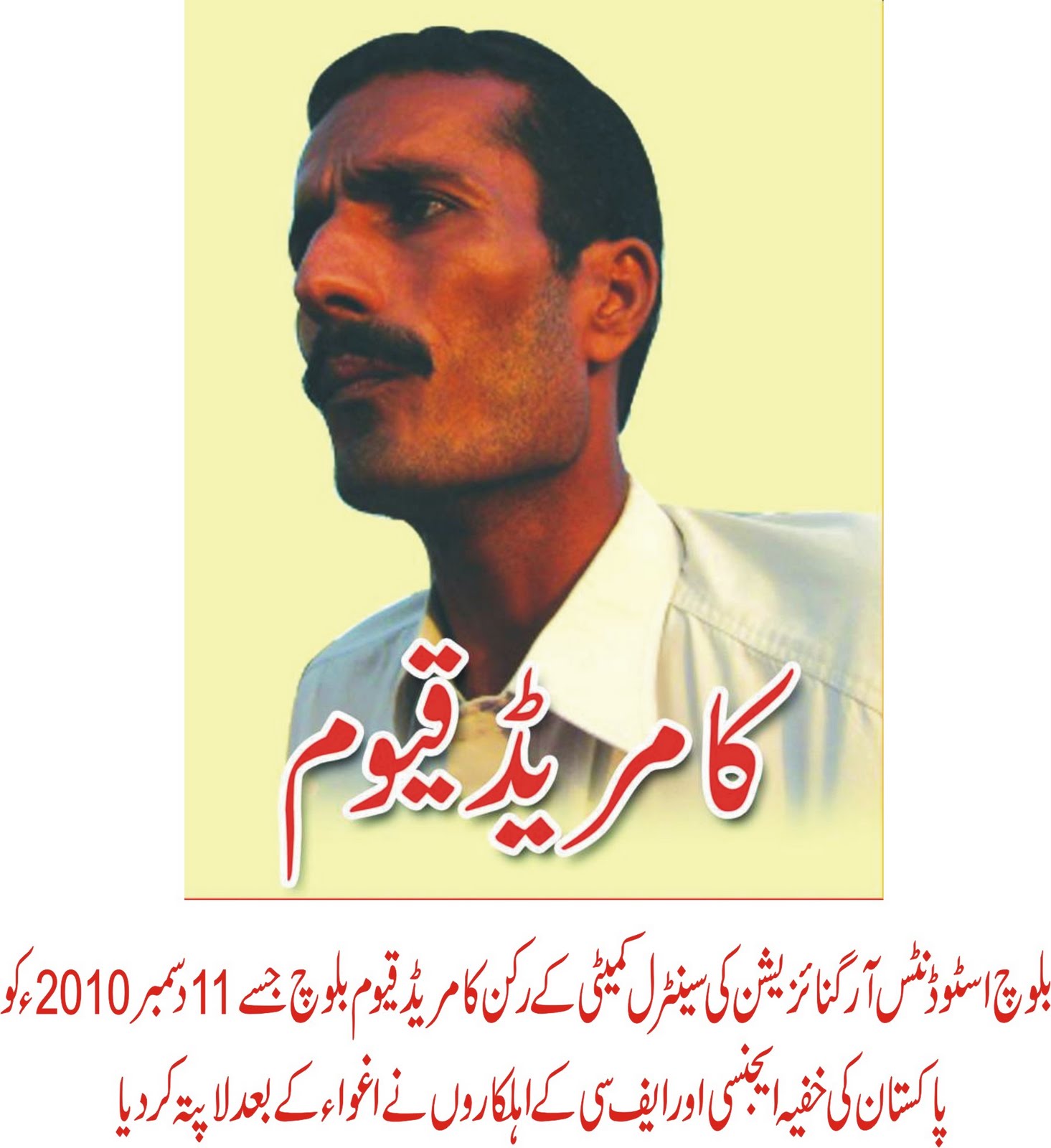
Comrade Kayyum Baluch


Comrade Kayyum Baluch, Central Committee member of Baloch Student Organisation abducted by Pakistani security forces on 11 December 2010 from Gowader Baluchistan.

Shutter down in Gwadar, Ormara against arrest of Baloch student, protest in Karachi


Occupied Balochistan: A Complete shutter down strike was observed in Gwadar, Ormara and adjoining townships on Sunday for the second consecutive day paralyzing life, business and trade activities, protesting against the hostage-taking of comrade Qayyum Baloch, senior member of Baloch Student Organization (BSO-Azad).

Students, including women in large number, took out a rally from Baloch Mohallah and marched through different parts of Gwadar city. The protesting students burnt tyres and put up barricades on several roads suspending flow of traffic for the day. The angry protestors also pelted commercial banks and official buildings with stones expressing their anger against the government and its functionaries for extra judicial arrest and murder in official custody. They chanted slogans against the security forces and secret agencies and accused them of whisking away innocent Baloch people.

A protest demonstration was held in front the Gwadar Press Club where speakers severely criticized the security forces saying that there is no law governing the unruly people in Government service. Information Secretary of BSO-Azad and relatives of Abdul Qayyum alleged that personnel in civil dress accompanied by Frontier Corps soldiers carried out raid in a house in Gwadar and whisked him away.

Dad Bakhsh, brother of Abdul Qayyum, lodged an FIR number 152/0/0 in Gwadar Police Station against the FC personnel accusing them of whisking away Abdul Qayyum.

Sources said that the angry people had besieged the residence of Minister for Fisheries Hammal Kalmati who then pressurized the concerned police officer to lodge the case. The students announced that strike will be continued today on Monday. It may be mentioned that Frontier Corps had categorically denied the allegations of carrying out raids and whisking away the people and termed it baseless and merely propaganda.

Meanwhile members of BNF held a protest rally at in Nuski against the abduction of Comerade Qayum Baloch and others. They chanted slogans against Pakistani security forces and demanded that the ongoing military operation in Balochistan must end immediately.

Karachi Protest: members and supporters of BSO-azaad also took to streets in Karachi against the abduction of Qayum Baloch. A large number of Baloch women and children participated in the protest rally and chanted slogans against the abductions and recovery of mutilated bodies of Baloch youth.

Courtesy: Balochistanexpress & DailyTawar

Report: The 6th International Conference against Disappearance 9 – 12 December, London


London: The three-day International Conference against disappearances ended successfully here on Sunday after a long March from Marble Arch to 10 Downing Street the official residence of British Prime minster. The conference was organised by ICAD and supported by International Voice for Baloch Missing Persons and other Organisations. The conference brought together the families and relatives of missing persons from different countries around the world. Delegates from 27 countries including Balochistan participated in the conference and shared their experiences and information about their respected countries – and the occupying states violence against National Liberation Movements.

Emotional moments were seen as the relatives of disappeared persons explained their ordeal and heartbreaking stories. It has been observed that almost all the brutal states and the occupying forces use the same methods of abduction, torture and violence against political and revolutionary activists. The conference emphasised the need of creating an International data base for the enforced disappeared persons around the world which should be easily accessible to the heads of National Organisation that are working against disappearances in their countries. The conference also recommended the creation of an International Solidarity network that should work on emergency bases and report any disappearances that occurs in any country around the world.

Several Human Rights Organisations and activists send their messages of support and congratulations to the ICAD, families of missing persons and other participants of the Conference. A message from Palestinian liberation fighter Leila Khaled was read out by Faiz Baluch which expressed solidarity with families of abducted persons around the world and urged those who enjoy liberty to continue their struggle for peace, justice and freedom. Her message further read that she was willing to attend the conference but the British authorities have refused her visa three times.

On the third day of the conference several resolutions were passed urging occupying states to release all political activists. The conference also recognised the National liberations struggles as the legitimised right of nations under occupation. (The complete resolution will be posted Shorty).

Brother of abducted Faiz Mohammad Marri posed the following questions:

“Before I end speech I would like to pose few questions to those who enjoy liberty: how do you deal with a situation when one of your family members disappears for a year! Maybe for five or ten years?

When the pro-claimed human rights organizations like UN close their eyes and ears to hear or notice your plea? How do you keep your sanity when your brother, father, son or daughter has vanished without a trace for a very long time and what do you do? How do you deal with the excruciating pain and the feeling of not knowing what happened your dearest ones? How do the mothers and the “widowed” women deal with the fading of their fiancés, husbands, sons and relatives for a long period of time by notorious forces? Is there any medicine or mechanism to deal with such an unbearable tragedy?

For those of you who luckily do not have anyone from your family member taken away, just do the following to at least feel a fraction of the pain that the families of the disappeared Baloch and other people fell; stop calling or talking to your loved ones for a year, two years, or five years! You will at least understand a little bit of what I am talking about”.

On the third day of conference 12-12-2010 a protest March was organised from Marble Arch to ten Downing Street, British PM official residence. The protest was carrying placards, banners and pictures of abducted person. They also chanted slogans and distributed leaflets for the release of political prisoners and the arrest of perpetrators of such crimes. The protesters also urged the western democracies to stop giving safe sanctuaries to dictators who after committing heinous crimes flee to Western capitals and live with impunity without any fear of being arrested or prosecuted.

More details of the conference and videos will be published soon, after an official statement by the ICAD (International Committee against Disappearance). (Some of the pictures of the conferenceand the protest March)

Sunday, 12 December 2010

Baloch youth abducted by Pakistan state after human rights day


Occupied Balochistan: Pakistan's security forces and secret services have abducted a Baloch youth in the port city of Gwadar, just a day after the international human rights day.

The victim has been identified as Abdul Qayyum Baloch, son of Nazar Mohammed Baloch. He has been abducted from his residence, Radio Gwank from Sweden reported.

Abdul Qayyum Baloch is a student and is a member of the pro-independence Baloch Students Organization Azad.

Enraged Baloch mobs laid a seige of the residence of Ghafoor Kalmati, minister for fihseries in the state government of Balochistan, and pelted it with stones, according to a phone call received here in USA.

Baloch resistance parties, struggling for an independent Balochistan, has recently changed its tactics and has begun targeting high-ranking Baloch officials in response to the enforced disapperances and extra judicial killings in Balochistan.

http://www.examiner.com/foreign-polic ... te-after-human-rights-day

Monday, 15 November 2010

Journalist protested against colleague's abduction, Sarmachaars saviour of Baloch Nation: BSO


Occupied Balochistan: A number Journalist protested in front of Pasni Press Club against the abduction of a member of Gawadar Press Club, Lala Hameed Baloch, and other Baloch activists. They were holding the play cards inscribed with slogans against the illegal arrests of Baloch activists and demands for the immediate recovery of all Baloch enforced-disappeared persons. 

According to details Journalists in the town of Pasni in Balochstan protested against the abduction of Lala Hameed Baloch, Naseer Kamalaan(member of BNM and well-known poet), Rheman Arif Baloch and other Baloch activists in front of Pasni press club. While addressing the crowd the organisers of the protest said that Pakistani forces were abducting the journalist for the only crime of being Baloch and such action on the part of the state tantamount to the suffocation of free media and stopping the journalists to do their duty independently. 

They further said that despite their warning and protest the government has not yet released Baloch Journalist Lala Hamid Baloch, Balochi language poet Naseer Kamalan Baloch and other Baloch activists. They appealed to the International Human Right Organizations to take immediate notice of abductions of Baloch activists. 

Mean while Baloch Student Organization’s members protested in the front of Pansi press club against the abductions and kill and dump tactics of Pakistani forces. The Protester was holding play cards and banners. They also appealed the United Nations to take the notice of the genocide Baloch Nation and disappearances of Baloch peoples. 

The BSO leaders while addressing the demonstration said that the Baloch were struggling for their national identity and freedom. They said that the current Baloch struggle for liberation was more organized and strong than of those in the past. The Baloch Student Oranisation said Baloch struggle for national liberation was gaining momentum on international level. They further said that the Baloch freedom fighters were struggling for an Independent Balochistan and it is every Baloch’s duty to support them because Sarmachars are the only saviour of Baloch Nation. In the end they said that Sarmaachars are fighting against Pakistani force occupation and for Baloch national honour and liberation.